Instrumented Mk4 TRNG read count
bigshiny0-2085547011743338845
- Author
- @bigshiny0
- Organisation
- independent
- Evidence role
- social statement
- Posted
- 7 Aug 2026, 02:02 UTC
- Capture status
- capture held
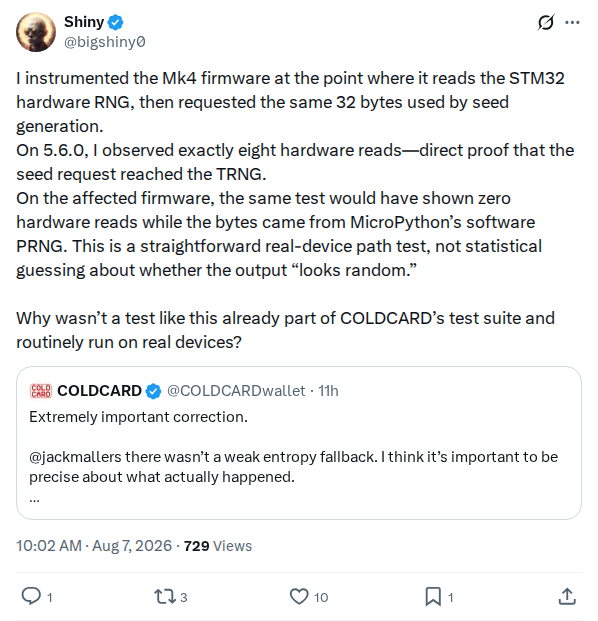
Shiny reports instrumenting Mk4 firmware at the point where it reads the STM32 hardware RNG and then requesting the same 32 bytes seed generation uses: on 5.6.0 exactly eight hardware reads were observed, which the poster reads as direct proof that the seed request reached the true RNG, and on affected firmware the same test is said to show zero hardware reads with the bytes coming from MicroPython's software PRNG instead. The post frames this as a real-device path test rather than statistical inspection of whether output looks random, and asks why such a test was not already in COLDCARD's suite and run routinely on hardware. It quotes the vendor's reply to another account insisting there was no weak entropy fallback and that precision matters, so it is a direct methodological answer to COLDCARD on what a test would actually settle. No instrumentation code, device identifier or log is published with it, and the affected-firmware half is stated as what the test would have shown rather than a run that was performed. The result and the inference are the poster's own and are not reproduced here.
This post is registered as evidence and has a locally held capture. The original remains the canonical publication. Last checked .
This post is held twice: here, with this project's own note on why it matters, and again as part of the conversation captured at , which is polled for changes. Both copies are the same post; neither is a separate event.
Snapshot and diff bodies for this chain monitor are held in the local evidence archive but withheld from the public site because they can contain the addresses of people who published nothing themselves. Capture times and reviewed change summaries remain available below.
Held captures
0 presentation-noise differences. Sidebar, ticker and other page chrome churn that our review classified as not being changes to what the source says.
The excerpts and plain unified diffs above show the text this project held and how it changed. To verify a quotation, compare it against the page itself or against the Internet Archive's copies, which are independent of this project.
Complete captures are held offline rather than mirrored here, so this page shows diffs and excerpts. If a quotation is ever disputed, the full copy can be produced. Ask.
Compare the screenshot or a quotation against the original while it is available.