Rebuttal of the vendor's fallback correction
jamesob-2085555839797166530
- Author
- @jamesob
- Organisation
- independent
- Evidence role
- social statement
- Posted
- 7 Aug 2026, 02:37 UTC
- Capture status
- capture held
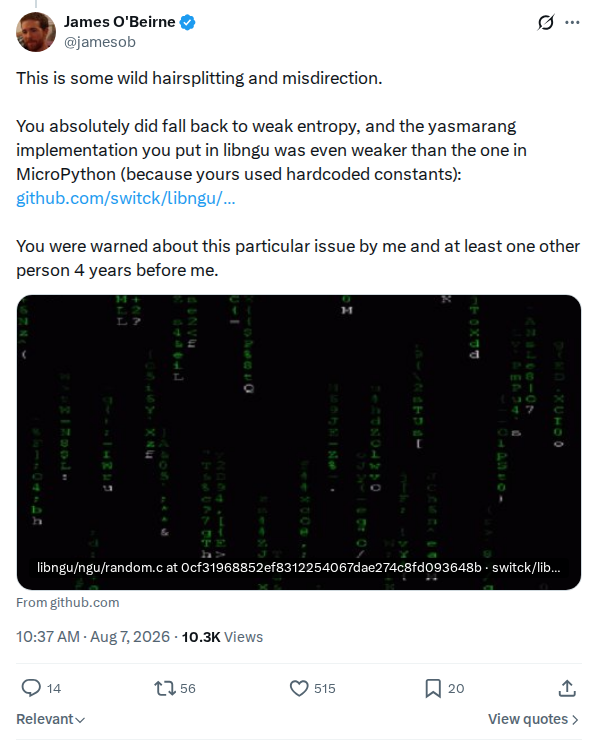
James O'Beirne replies to Coinkite's "extremely important correction" to Jack Mallers, held at coldcardwallet-2085541034243600805, which argued there was no weak-entropy fallback and that Yasmarang was MicroPython's general-purpose RNG reached through a link-time error. O'Beirne calls that hairsplitting and misdirection, says the device absolutely did fall back to weak entropy, and says the Yasmarang implementation placed in libngu was weaker than MicroPython's because it used hardcoded constants, linking a pinned commit and line range in switck/libngu ngu/random.c. He adds that he warned Coinkite about this issue and that at least one other person did four years before him. This is a direct exchange between the vendor and the auditor whose disclosure history the record already carries; the file he cites is itself held at libngu-random-c, so the comparison can be checked against the source rather than taken on assertion. The warning history and the characterisation of the correction are his own.
This post is registered as evidence and has a locally held capture. The original remains the canonical publication. Last checked .
This post is held twice: here, with this project's own note on why it matters, and again as part of the conversation captured at , which is polled for changes. Both copies are the same post; neither is a separate event.
Snapshot and diff bodies for this chain monitor are held in the local evidence archive but withheld from the public site because they can contain the addresses of people who published nothing themselves. Capture times and reviewed change summaries remain available below.
Held captures
0 presentation-noise differences. Sidebar, ticker and other page chrome churn that our review classified as not being changes to what the source says.
The excerpts and plain unified diffs above show the text this project held and how it changed. To verify a quotation, compare it against the page itself or against the Internet Archive's copies, which are independent of this project.
Complete captures are held offline rather than mirrored here, so this page shows diffs and excerpts. If a quotation is ever disputed, the full copy can be produced. Ask.
Compare the screenshot or a quotation against the original while it is available.