The False Promise of Commercial Hardware Wallets
stackernews-false-promise-commercial-hww
- Organisation
- Stacker News
- Evidence role
- Community discussion
- Published
- 2026-07-31
- Source changes
- 0
- Detected differences
- 0
- Unreviewed
- 0
- Copies held
- 1
hasherstacker's essay 'The False Promise of Commercial Hardware Wallets', arguing the incident indicts the product category rather than one vendor. Opinion, attributed to the author. Captured through the site's public GraphQL API: the rendered pages crash the capture tab, and the API answers POST from this host. The query fixes the captured surface to the item's title, text and two levels of comments, each with author and absolute timestamp.
Every check is recorded, including checks that found no text change. A detected edit is therefore bounded between two checks. The publisher's exact save time is not observable from this record. Last checked .
This post is held twice: here, with this project's own note on why it matters, and again as part of the conversation captured at , which is polled for changes. Both copies are the same post; neither is a separate event.
Snapshot and diff bodies for this chain monitor are held in the local evidence archive but withheld from the public site because they can contain the addresses of people who published nothing themselves. Capture times and reviewed change summaries remain available below.
Held captures
-
Recovered from the Internet Archive rather than captured by this project. The row records that third-party provenance separately from captures made by this project.
What changed from the previous capture 0 lines
Extracted text as captured
{ "data": { "item": { "comments": { "comments": [ { "createdAt": "2026-07-31T19:18:14.375Z", "text": "I also preached the 3 levels stash: vault, cache, spending.\nWith multiple wallets, on multiple levels.\nA cold wallet is supposed to NEVER touch and open (sign), you only deposit through a xpub.\n\n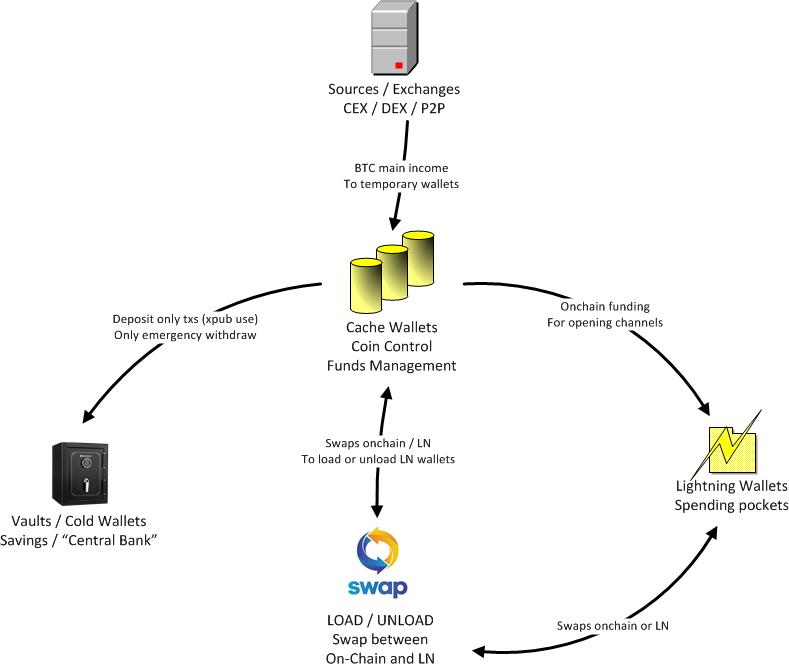", "user": { "name": "DarthCoin" } }, { "createdAt": "2026-07-31T18:20:34.596Z", "text": "> build your own cold wallet with a cheap USB stick, TailsOS, and Electrum. No proprietary chips. No NDA'd secure elements. No marketing department. Just a clean, offline OS that wipes itself when you shut down, running open-source software you can actually read.\n\nI mean, P(*I mess up*) **>** P(*I'm exposed to hacks via e.g., Coldcards or faulty Trezors*)", "user": { "name": "denlillaapan" } }, { "createdAt": "2026-07-31T22:39:39.174Z", "text": "Thanks for mentioning my old post:)", "user": { "name": "Natalia" } }, { "createdAt": "2026-07-31T17:52:45.733Z", "text": "> @justin_shocknet once put it perfectly in a post about the whole ecosystem: *\"Trezor, Ledger, Coldcard: all run on microcontrollers with closed boot ROMs. Their 'secure elements' are under NDA. Their true behavior is inaccessible. You cannot verify what code is executing. You cannot prevent what you cannot see.\"* **\"The Lie of the Lock: A Meditation on the Fraud of Modern Cryptography\"** — Here: https://stacker.news/items/1008583.\n\nStill true... \n\nIrony in the Coldcard case however was that the vulnerability came from the one thing you arguably *could* verify, and nobody did... for years... despite everyone recommending it and bleating \"Don't trust, verify\" just to virtue signal", "user": { "name": "justin_shocknet" } } ] }, "createdAt": "2026-07-31T17:43:30.921Z", "text": "The False Promise of Commercial Hardware Wallets\n\n# Why Your Fancy Hardware Wallet Might Be Worth Your Trust\n\nLook, nobody wants to hear this. You just dropped $150–$250 on a shiny little gadget with a tamper-evident seal, watched a dozen YouTube unboxings, and finally felt *safe*. I get it. But here's the thing nobody in the hardware wallet business wants to say out loud:\n\n**Almost every commercial hardware wallet is vulnerable.** Not just ColdCard. Not just the one brand that happens to be getting dunked on this week. *Almost all of them.* And the worst part? You're paying a premium for the privilege of being lied to.\n\n## The Marketing Trap\n\nEver notice how when one hardware wallet company takes a hit, the others suddenly start acting like they just invented cryptography? Trezor drops a thread. Blockstream Jade gets recommended by every influencer overnight. Ledger starts running ads about how *their* secure element is EAL6+ certified, as if that means anything when the real attack happens in a JavaScript library.\n\nIt's not a security race. It's a **market-share scramble**. These may certainly be profitable consumer products first, security devices second. The louder they shout about being \"the best option,\" the more you should squint.\n\n@justin_shocknet once put it perfectly in a post about the whole ecosystem: *\"Trezor, Ledger, Coldcard: all run on microcontrollers with closed boot ROMs. Their 'secure elements' are under NDA. Their true behavior is inaccessible. You cannot verify what code is executing. You cannot prevent what you cannot see.\"* **\"The Lie of the Lock: A Meditation on the Fraud of Modern Cryptography\"** — Here: https://stacker.news/items/1008583.\n\n## The Attacks Are Real, and They're Not Going Away\n\nLet's talk specifics, because \"vulnerable\" is just a word until you see the receipts.\n\n**Supply chain attacks** are the scariest ones because they scale. You don't need to be targeted individually. One compromised library, one bad firmware update, and thousands of users get drained at once. Remember the **Ledger Wallet's LedgerHQ/connect-kit hit by supply chain attack : https://stacker.news/items/352236**? A former employee's unrevoked NPM API key let attackers push malicious JavaScript that stole between **$484K and $600K** from dApp users. The hardware wallets themselves weren't \"hacked\"—the code *around* them was poisoned. \n\nThen there's the physical stuff. Voltage glitching, laser fault injection, side-channel power analysis. A SN discussion with the Foundation Passport team openly admitted: *\"Every chip is vulnerable to these kinds of targeted, sophisticated attacks... Contrast to something like a Trezor, which does not use a secure element and can be trivially voltage-glitched using $100 of hardware.\"* Here: https://stacker.news/items/85228\n\nAnd let's not forget **Dark Skippy**—malicious firmware that hides secret data inside your transaction signatures, slowly leaking your seed without you ever knowing. Or the **ESP32 vulnerability (CVE-2025-27840)** that hit chips used in devices like Blockstream Jade, with \"insufficient entropy\" in the random number generator. That's the thing generating your private keys. Let that sink in.\n\nThe industry response? \"Update your firmware.\" But as one Stacker News commenter noted, *\"I don't think never upgrading a firmware is a best practice\"*—yet every update is another trust fall into the manufacturer's hands. \n\n## The DIY Alternative: Actually Own Your Security\n\nSo what's the move? Hand your keys to an exchange? Obviously not. There's a better way, and it's been sitting right in front of us.\n\n**@DarthCoin** has been preaching this for years: build your own cold wallet with a cheap USB stick, TailsOS, and Electrum. No proprietary chips. No NDA'd secure elements. No marketing department. Just a clean, offline OS that wipes itself when you shut down, running open-source software you can actually read.\n\nA Stacker News user wrote a beautiful step-by-step guide on exactly this: *\"What if the whole point of Bitcoin is about self-responsibility, which includes making your own cold wallet?\"* They walk through buying a USB with cash, flashing TailsOS, creating persistent encrypted storage, generating seeds offline in Electrum, and verifying everything before touching a single sat. \n\nThe guide is here, and it's gold: How to MAKE your own Cold Wallet : https://stacker.news/items/569901\n\nThe benefits? It's private (no KYC, no shipping address, no leaked customer database). It's low-key (nobody knows that random USB in your drawer holds Bitcoin). And it's *dirt cheap*—stack more sats instead of funding another hardware wallet marketing budget.\n\nAnother killer option is **[SeedSigner](https://seedsigner.com/)**—a fully open-source, DIY signing device built from a Raspberry Pi Zero and a camera module, usually for under $50. No corporation. No profit motive. Just reproducible builds and code you can audit yourself. \n\n## The Profit Motive Problem\n\nHere's why this matters: when a company sells you a hardware wallet, they're not selling you *security*. They're selling you **the feeling of security**. And feelings are profitable.\n\nEvery time one HWW stumbles, other HWW companies don't rush to make their devices better. They rush to make their *ads* better. They don't fix the closed boot ROMs. They don't open-source the secure element firmware (because they legally can't). They just tweet harder.\n\nAs that same Stacker News meditation on modern cryptography warned: *\"They do not need to hack your device if it helped write the firmware. It does not need to ask for your key if it can control the enclave that stores it.\"* \n\n## What Actually Works\n\nIf you're not ready to go full DIY, at least diversify. Don't put all your trust in one shiny device from one company. Use multisig across different setups. Pair a SeedSigner with a TailsOS USB stick. Or check out projects like Specter Enclave : https://stacker.news/items/982650, which turns your Mac's Secure Enclave into a signing device with Touch ID—using hardware you already own, with open-source code you can audit. \n\nBut honestly? The most sovereign move is the simplest one. A $5 USB stick. TailsOS. Electrum. KeePassXC. Offline. Verified. Yours. Here: [DarthCoin's Substack: Build your HODL BTC cold wallet](https://darthcoin.substack.com/p/build-your-hodl-btc-cold-wallet)\n\nBecause at the end of the day, the question isn't \"which hardware wallet is the best?\" The question is: **best for whom?** The company selling it, or you?\n\n---\n\n### Sources & Further Reading\n\n\n- [Your Mac has a hardware wallet in it. You just aren't using it yet.](https://stacker.news/items/982650) — Specter Enclave on Stacker News\n- [Stop trying to use dice-rolled seeds unless you're an expert ❌](https://stacker.news/items/426148) — Stacker News on entropy mistakes", "title": "The False Promise of Commercial Hardware Wallets", "user": { "name": "hasherstacker"Excerpt only. The complete copy is held offline and backs quotations on this site. The original publication remains the canonical public source.
0 presentation-noise differences. Sidebar, ticker and other page chrome churn that our review classified as not being changes to what the source says.
The excerpts and plain unified diffs above show the text this project held and how it changed. To verify a quotation, compare it against the page itself or against the Internet Archive's copies, which are independent of this project.
Complete captures are held offline rather than mirrored here, so this page shows diffs and excerpts. If a quotation is ever disputed, the full copy can be produced. Ask.
Compare the screenshot or a quotation against the original while it is available.