Coldcard: the technical autopsy of an entropy failure
stackernews-technical-autopsy-entropy-failure
- Organisation
- Stacker News
- Evidence role
- Community discussion
- Published
- 2026-08-11
- Source changes
- 0
- Detected differences
- 0
- Unreviewed
- 0
- Copies held
- 1
k00b relaying a detailed postmortem that claims the Mk3 and Mk4 candidate spaces are smaller than previously reported, estimates sweep costs and collision probabilities, and compares device-class vulnerability. The numerical claims are the author's and are reported here without endorsement; the thread is a significant technical counterpoint to earlier published estimates. Captured through the site's public GraphQL API: the rendered pages crash the capture tab, and the API answers POST from this host. The query fixes the captured surface to the item's title, text and two levels of comments, each with author and absolute timestamp.
Every check is recorded, including checks that found no text change. A detected edit is therefore bounded between two checks. The publisher's exact save time is not observable from this record. Last checked .
This post is held twice: here, with this project's own note on why it matters, and again as part of the conversation captured at , which is polled for changes. Both copies are the same post; neither is a separate event.
Snapshot and diff bodies for this chain monitor are held in the local evidence archive but withheld from the public site because they can contain the addresses of people who published nothing themselves. Capture times and reviewed change summaries remain available below.
Held captures
-
Recovered from the Internet Archive rather than captured by this project. The row records that third-party provenance separately from captures made by this project.
What changed from the previous capture 0 lines
Extracted text as captured
{ "data": { "item": { "comments": { "comments": [ { "createdAt": "2026-08-12T00:05:45.584Z", "text": "Nice data, but I hate to say it: the writing has that distinctive sloptastic vibe to it, and my aesthetic reaction to it is so bad that I can't bring myself to read the otherwise very interesting analysis. I was especially interested in the birthday paradox section, but paragraphs like:\n\n> This model does not describe the real firmware, and it is worth saying so straight away. `_start_scan()` is only called at the beginning of a burst, and a burst only closes 250 milliseconds after the last release, at `mempad.py:159`. 2 people entering a PIN of the same length do not, then, consume the same number of draws: the fast typist chains several keys into a single burst, the hesitant one triggers a burst per key. Add to that backtracking, abandoned attempts, mistyped entries, and the `_rand_below()` loop that redraws when a draw is rejected. The generator’s real rank at creation time depends on typing cadence, not on PIN length.\n\ngot me gagging", "user": { "name": "SimpleStacker" } } ] }, "createdAt": "2026-08-11T23:52:53.482Z", "text": "This is *very* detailed postmortem of the coldcard vulnerability correcting the candidate space sizes (they are smaller than previously reported), estimating the probability of collisions among devices, and estimating the cost of sweeping the candidate spaces for each device class under different assumptions.\n\nFor Mk3s without passphrases or dice rolls, you can test the sweepability of nearly all candidates for $61 of rented RTX 4090 time \\~9 days on a single RTX 4090. In comparison it takes years to do the same for Mk4 class devices even assuming more information is known.\n\n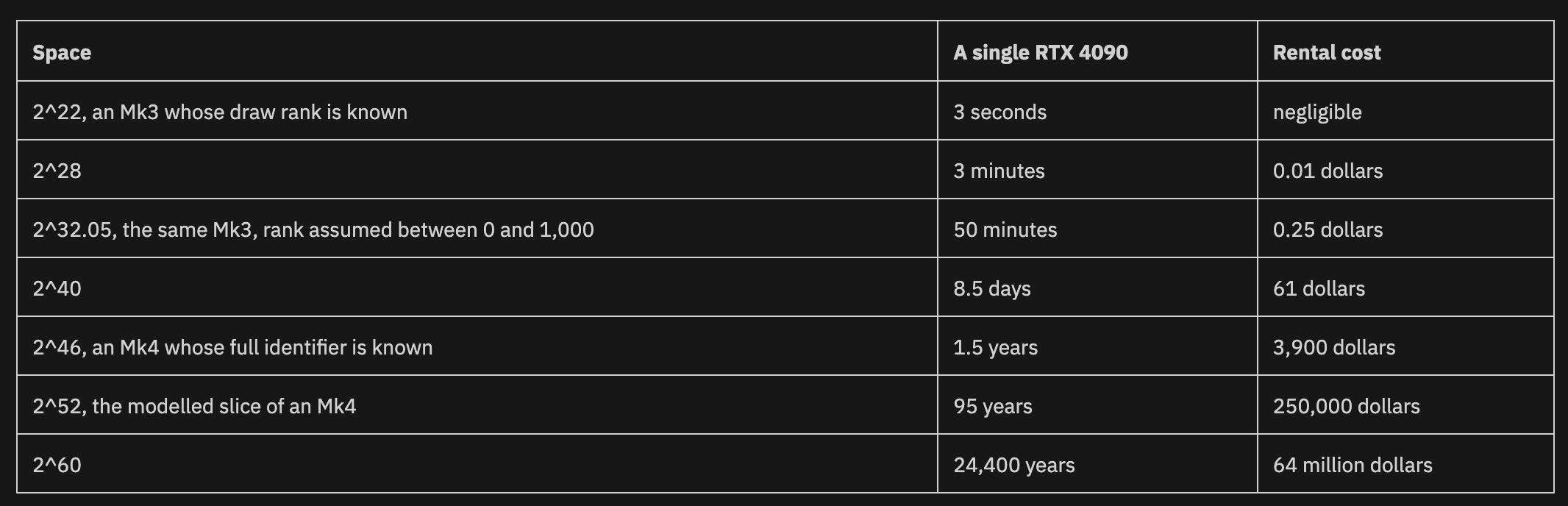\n\nThe candidate space for the mk3 is hundreds of thousands of times, and a million times for mk4 class devices, smaller than Block and others published.\n\n\n\nAnd, assuming a fleet of 30,000 mk3 devices and a few other things, they put they likelihood of collisions at 1 in 1,000.\n\nThere's lot of bits in here that weren't in the earlier reports for anyone that's a detail devil.", "title": "Coldcard: the technical autopsy of an entropy failure", "user": { "name": "k00b" } } } }Excerpt only. The complete copy is held offline and backs quotations on this site. The original publication remains the canonical public source.
0 presentation-noise differences. Sidebar, ticker and other page chrome churn that our review classified as not being changes to what the source says.
The excerpts and plain unified diffs above show the text this project held and how it changed. To verify a quotation, compare it against the page itself or against the Internet Archive's copies, which are independent of this project.
Complete captures are held offline rather than mirrored here, so this page shows diffs and excerpts. If a quotation is ever disputed, the full copy can be produced. Ask.
Compare the screenshot or a quotation against the original while it is available.